

Why Does Courage Feel So Hard? The Nervous System Science Behind Fear and Bravery
By Destinē The Leader | Energy of Creation
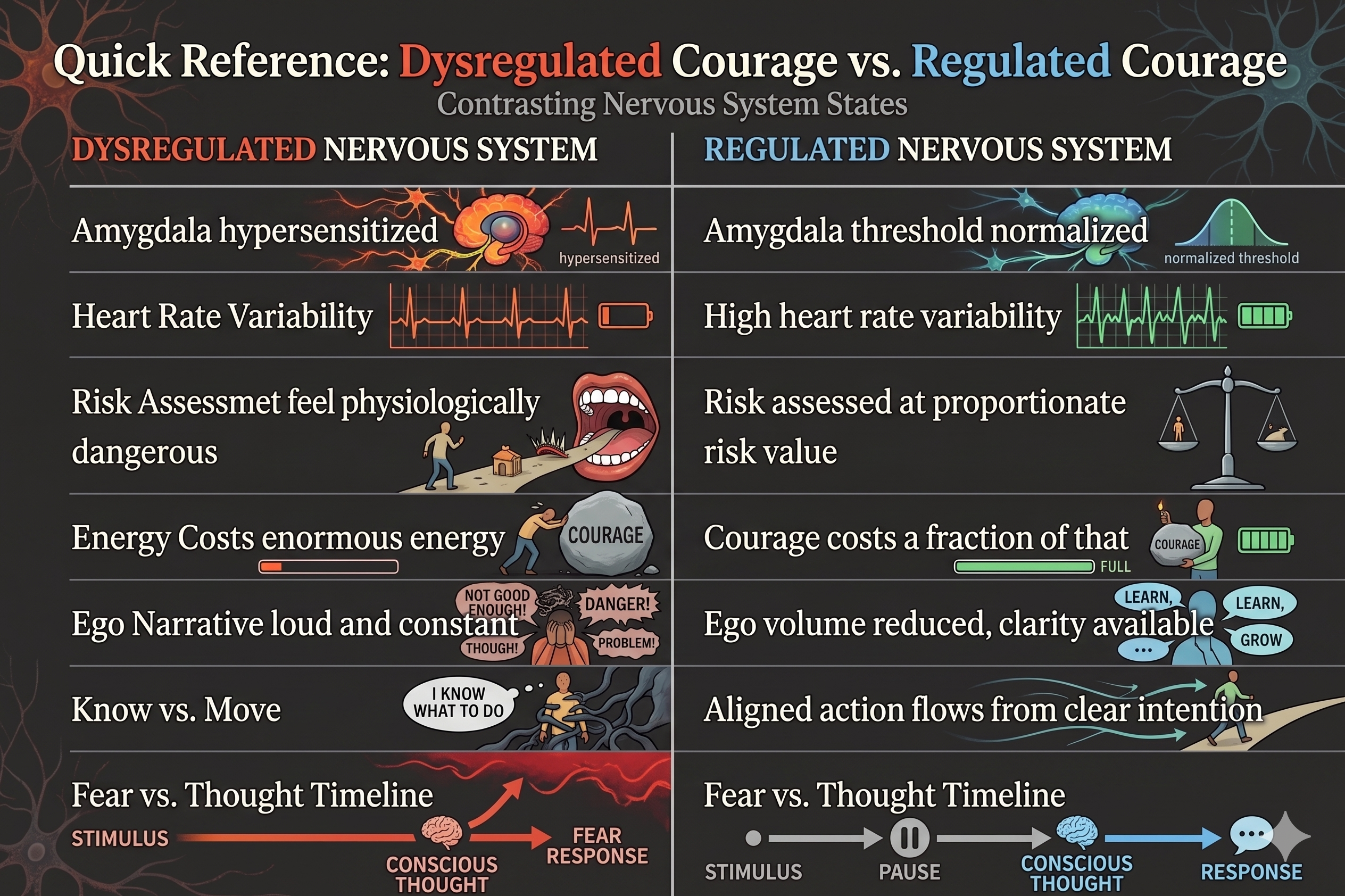
Courage feels hard when the nervous system is dysregulated — not because the person lacks bravery, but because chronic stress lowers the amygdala's threat threshold, making ordinary risks feel physiologically dangerous. Fear is not primarily a mental experience. It is a full-body physiological state driven by the autonomic nervous system. When cortisol is chronically elevated and the threat-detection system is hypersensitized, the neurological cost of any courageous act increases dramatically — regardless of the person's values, intentions, or desire to move forward. Nervous system regulation through conscious breathwork, somatic practice, and A Course in Miracles reduces that cost by recalibrating the fear response at its biological source.
Why Courage Keeps Failing — Even When You Want It
Let's start with the moment most people don't talk about.
Not the one where you did the brave thing. The one right before it — where you knew what needed to happen, could see it clearly, wanted it genuinely, and still couldn't make yourself move.
The conversation you've been putting off for three months. The project you've been building toward that you keep almost launching. The version of yourself you can see but can't quite inhabit. The help you need but haven't asked for.
Most courage advice focuses on mindset — embrace your fears, do it scared, push through. And there is truth in that. But it skips the most important variable for high performers specifically: why courage requires so much more energy than it should, and what is actually making it that hard.
Because what looks like a courage problem is almost always a nervous system problem.
What Does Fear Actually Do to the Body?
Is Fear a Mental or Physical Experience?
Fear is both — but it begins as a physical event, not a mental one. And this distinction changes everything about how to address it.
When a perceived threat is detected — whether it is a physical danger or a high-stakes conversation — the amygdala fires. Stress hormones including adrenaline and cortisol are released within milliseconds. Muscles tighten. Breathing shallows. Heart rate increases. The body mobilizes for fight, flight, or freeze before the conscious mind has had time to evaluate whether the threat is real.
This physiological cascade happens faster than thought. Which is why thinking about courage — reframing the fear, reminding yourself of your values, running mental rehearsal — often fails to produce the physical readiness to act. The body's threat response is already running before the rational mind has a vote.
What Is the Amygdala's Role in Courage and Fear?
The amygdala is the brain's primary threat-detection structure — a small, almond-shaped region that processes emotional memory and triggers the stress response. Under chronic stress, the amygdala becomes hypersensitized. Its threat threshold lowers. Situations that a regulated nervous system would assess as manageable — a difficult conversation, a public risk, a moment of genuine vulnerability — register to a dysregulated amygdala as genuinely dangerous.
This is the specific mechanism behind the high-performer courage problem. It is not that the person lacks courage. It is that their amygdala is running a calibration that was set under sustained pressure — and that calibration makes everything feel higher stakes than it objectively is.
Why Do High Performers Specifically Struggle With Courage?
High performers are disproportionately likely to be operating from chronic nervous system activation. The same drive, intensity, and high-stakes environment that produces achievement also produces sustained cortisol elevation — which over time hypersensitizes the amygdala, lowers the threat threshold, and raises the neurological cost of every courageous act.
This creates a specific paradox: the more someone has achieved under pressure, the more their nervous system may have been conditioned to treat risk as threat — making the very courage required for the next level of growth feel physiologically inaccessible, regardless of their conscious desire to move forward.
The Neuroscience of Regulated Courage
What Happens to Fear When the Nervous System Is Regulated?
When the nervous system is consistently regulated — when cortisol is reduced, heart rate variability is high, and the parasympathetic system is dominant — the amygdala's threat threshold normalizes. Things that previously felt dangerous begin to register at a more accurate, proportionate level.
This is not the elimination of fear. Some things should still carry weight — the meaningful risks, the vulnerable moments, the leaps that matter. That is appropriate. That is being human.
What changes is the baseline. The amount of fear generated by things that are not actually that dangerous drops significantly. The physiological cost of courage decreases. What used to require everything available starts requiring a fraction of it. That freed-up capacity goes somewhere — into action, into creativity, into the actual doing of the thing being circled.
What Is Heart Rate Variability and Why Does It Matter for Courage?
Heart rate variability (HRV) is the variation in time between consecutive heartbeats — a primary biomarker of nervous system resilience and adaptability. High HRV indicates a nervous system that can handle demands, recover quickly, and shift between activation and rest efficiently. Low HRV indicates a nervous system running in sustained stress that has lost adaptive flexibility.
Research consistently associates high HRV with greater emotional regulation, more proportionate stress responses, and higher tolerance for uncertainty and risk — all foundational components of courage. Conscious breathwork is one of the most evidence-supported methods for improving HRV.
How EOC Practices Build the Capacity for Courage
How Does Conscious Breathwork Help With Fear and Courage?
In a full conscious breathwork session, the participant encounters something that requires genuine courage: the breath asks you to go somewhere you do not fully control — to feel what has been held, to stay present with intensity the body's instinct is to avoid.
Every time this happens — every time the breath is followed through the edge rather than pulled back from — the nervous system learns something new: I can handle this. I can feel this and not be destroyed by it. That learning is somatic. It is encoded in the body, not just the mind. And it transfers directly to daily life.
This is why consistent breathwork practitioners report not just feeling calmer, but acting with more decisiveness — in conversations, in creative risks, in life choices that previously felt inaccessible. The regulation practice builds courage as a byproduct of building physiological resilience.
What Does A Course in Miracles Teach About Fear and Courage?
A Course in Miracles identifies fear with precision that few frameworks match. The Course teaches that every experience of fear is the ego's response to love, truth, and expansion — that fear is always, at its root, the resistance of the fear-based operating system to who you actually are and what you are actually here to do.
Courage in ACIM terms is not overcoming fear through force. It is choosing love over the ego's insistent narrative of threat — consistently, in the small moments as much as the large ones. The daily ACIM practice literally rewires the perceptual lens through which potential and risk are interpreted. Over time, it reduces the ego's volume and creates more internal space for the clear, aligned action that genuine courage produces.
How Does Community Support Courageous Action?
There is a specific kind of courage that only becomes available in the presence of others doing the same thing.
When you move your body freely in a room full of people doing the same — when you breathe together in a container that holds vulnerability without judgment — something in the nervous system updates its sense of what is safe. What felt exposing becomes practiced. What felt risky becomes normalized.
The Energy of Creation community functions as a courage training environment precisely because it is a regulation environment. Co-regulation is real. Being in consistent contact with people who are acting courageously — who are doing the inner work, taking the aligned risks, being honest about where they are — recalibrates your own nervous system's sense of what is possible and what is safe to attempt.
What Is Ecstatic Dance's Role in Building Courage?
Moving freely, without choreography, without performance, in a room where that is what everyone is doing — is one of the smallest and most profound acts of courage most adults have never tried. It requires dropping the managed self and showing up as you actually are.
That practice has an effect that extends beyond the dance floor. Every time the managed self is set down voluntarily and the authentic self moves in its place, the nervous system's sense of what is survivable expands. The threshold for courage in other domains rises.
The Bravest Thing for High Performers
The bravest thing for most high performers is not a dramatic external leap. It is the internal one.
Stopping long enough to feel what is underneath the motion. Letting yourself want what you actually want instead of what seems reasonable. Asking for help before reaching crisis. Being honest about where you are instead of performing where you think you should be.
These things require a regulated nervous system — not because they are physically dangerous, but because the ego treats them as existential threats. When the nervous system is already maxed out, the ego's volume is at its highest.
Regulation turns down the volume. And in the quiet, the brave thing becomes clear.
Build the Foundation for Courage
Super Sunday is EOC's monthly online conscious breathwork gathering — one hour, first Sunday of every month. A complete session that gives the nervous system direct experience of the physiological state where genuine courage becomes accessible.
BIG VISION is EOC's annual membership for high performers building the full foundation — conscious breathwork, A Course in Miracles, sound healing, ecstatic dance, and a community that normalizes courageous, aligned action.
Quick Reference: Dysregulated Courage vs. Regulated Courage
Energy of Creation is a 508(c)(1)(a) nonprofit wellness community based in Temple/Belton, Central Texas. Our mission: Breaking Cycles, Building Futures.