

Why Can't I Feel Happy Even When Life Is Good? The Science of Joy Capacity and Nervous System Regulation
By Destinē The Leader | Energy of Creation
The inability to feel happy even when life is objectively good is not a gratitude problem, a mindset problem, or a character flaw — it is a biological condition called hedonic adaptation, compounded by nervous system dysregulation. Chronic stress progressively desensitizes the brain's reward circuitry, reducing its capacity to generate feelings of pleasure, satisfaction, and genuine joy regardless of external circumstances. Happiness is not just a choice — it is a capacity that must be actively built through nervous system regulation, somatic release, and consistent community. Conscious breathwork, sound healing, A Course in Miracles, and embodied movement are among the most effective tools for rebuilding that capacity at its physiological source.
Why "Happiness Is a Choice" Is Incomplete Advice
"Happiness is a choice."
You have heard it. Maybe you have said it. And there is something true in it — intention matters, perspective matters, what we focus on shapes what we experience.
But for a lot of high performers, "happiness is a choice" lands as quiet accusation. If you are not happy, the implication is that you are choosing wrong. That you just need to decide differently. That the gap between where you are and where you want to be is a failure of will.
That framing is not just incomplete. For people who are already working hard, already trying, already doing everything they know to do — it can be actively harmful. Because it locates the problem in the person's choosing rather than in the conditions that make certain choices physiologically inaccessible.
Here is the more complete truth: happiness is not only a choice. It is a capacity. And capacity has to be built — through practice, through regulation, through the slow, real work of creating internal conditions where joy, ease, and genuine aliveness can actually live.
You cannot choose your way to a feeling your nervous system is not generating.
What Is Hedonic Adaptation and Why Does It Affect High Achievers?
What Is Hedonic Adaptation?
Hedonic adaptation is the neurological and psychological process by which people return to a relatively stable baseline level of happiness despite significant positive or negative life changes. In high performers, hedonic adaptation is accelerated and compounded by chronic stress — creating a specific pattern where achievement produces diminishing emotional returns over time.
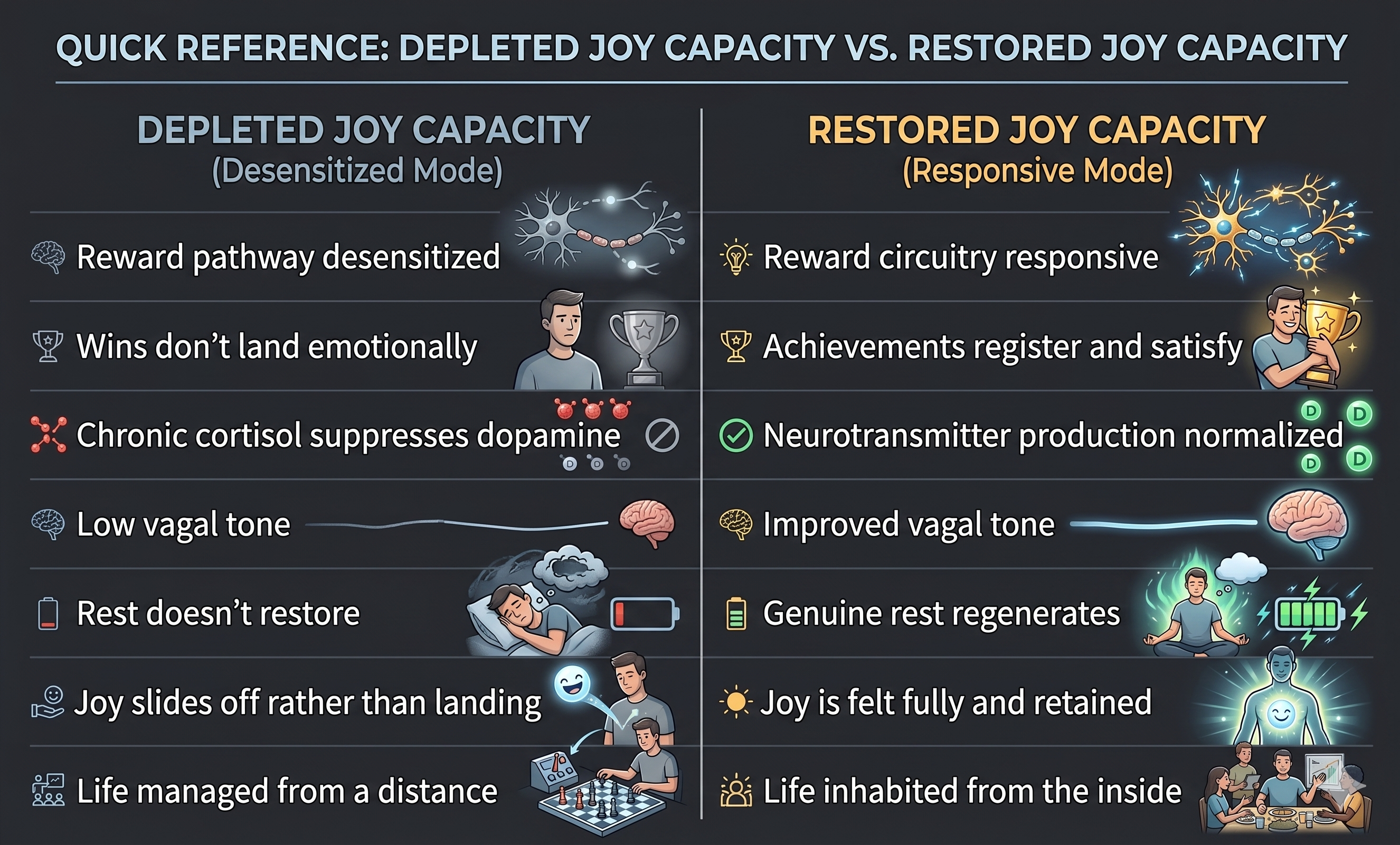
Here is what this looks like biologically: chronic stress keeps the body in a sustained state of sympathetic activation. Cortisol stays elevated. The nervous system stays on guard. The brain's reward circuitry — the dopaminergic system responsible for generating feelings of pleasure, satisfaction, and genuine joy — becomes progressively less responsive under sustained stress. The technical term is reward pathway desensitization. The lived experience is that things that should feel good simply do not, quite.
The wins do not land. The rest does not refresh. The milestones that were supposed to be enough never feel like enough.
Why Do High Performers Feel Empty Despite Success?
This is not a gratitude problem. It is not a mindset problem. It is the predictable biological result of running a high-performance system without adequate recovery, regulation, or genuine restoration.
The specific cruelty for high achievers is this: the harder you work to produce the outcomes you believe will finally generate happiness, the more deeply you entrench the physiological conditions that make happiness harder to access. Achievement and aliveness move in opposite directions — until something interrupts the cycle.
That interruption is not a better goal or a more inspiring vision. It is nervous system regulation.
The Neuroscience of Joy Capacity
What Does the Nervous System Have to Do With Happiness?
The autonomic nervous system — specifically the balance between sympathetic activation (fight-or-flight) and parasympathetic regulation (rest-and-digest) — directly governs the body's capacity to access positive emotional states.
When the sympathetic system is chronically dominant, cortisol suppresses the production of dopamine, serotonin, and oxytocin — the neurotransmitters most associated with wellbeing, connection, and joy. The body is not generating the neurochemical substrate that happiness requires, regardless of what is happening externally.
When parasympathetic regulation is restored through consistent practice — breathwork, movement, rest, community — neurotransmitter production normalizes. The reward circuitry becomes responsive again. Joy begins to land the way it was supposed to.
What Is the Vagus Nerve's Role in Happiness?
The vagus nerve is the primary pathway of the parasympathetic nervous system — running from the brainstem through the heart, lungs, and digestive system. Vagal tone, a measure of vagus nerve activity, is directly associated with emotional regulation, social connection, and the capacity for positive affect.
Conscious breathwork — particularly slow, rhythmic breathing with extended exhales — is one of the most evidence-supported methods for improving vagal tone. Improved vagal tone increases the nervous system's capacity for the parasympathetic states where genuine happiness, ease, and connection are most accessible.
What A Course in Miracles Teaches About Happiness
Why Does the Ego Resist Happiness?
A Course in Miracles offers one of the sharpest perspectives on chronic unhappiness I have encountered, and it goes somewhere most psychology frameworks do not.
The Course teaches that the ego — the fear-based operating system most people have been running since early childhood — has a deep, largely unconscious investment in maintaining unhappiness. Not because it is malicious, but because unhappiness is familiar. Familiar feels safe to the ego. Familiar is predictable. And the ego, above all things, fears the unknown — including the unknown of what genuine happiness, expansion, and wholeness would actually require.
This is why "just choose happiness" rarely works as instruction. The ego is not neutral in the choosing. It actively generates evidence that happiness is unsafe, undeserved, temporary, or naive. It catastrophizes joy. It locates the problem in every good thing. It waits for the other shoe.
How Does ACIM Practice Build Capacity for Joy?
Undoing the ego's investment in unhappiness is not a matter of trying harder to be positive. It is a matter of working at the level where the programming lives — which is below conscious choice, in the nervous system, in the body, in the deep conditioning that shapes what feels possible before any conscious decision is made.
The ACIM daily practice — 365 lessons designed to systematically shift perception from fear-based to love-based — works directly on this level. Over months and years of consistent practice, the ego's grip on unhappiness loosens. Not through force. Through the disciplined, patient work of choosing a different perception, one moment at a time.
How EOC Practices Rebuild Joy Capacity
How Does Conscious Breathwork Restore the Capacity for Joy?
When the nervous system shifts from chronic activation into genuine regulation through breathwork — when cortisol drops, when the parasympathetic system becomes dominant, when the reward circuitry receives the signal that it is safe to operate — people frequently describe an experience that is difficult to articulate: things begin to feel good again.
Not in a performed, forced-gratitude way. In the way that a full breath feels good. In the way that rest actually restores. In the way that a moment of genuine connection lands fully rather than sliding off.
This is not a mood improvement. It is a capacity restoration. The nervous system has received enough consistent safety signals to allow the reward circuitry to come back online.
How Does Somatic Release Support Happiness?
Happiness is not only the presence of good feeling — it is also the absence of what has been suppressing it. Years of unprocessed emotion, unacknowledged grief, unfelt anger, and accumulated tension create a form of internal weight that mutes the full range of experience including joy.
Breathwork, sound healing, and embodied movement create conditions for that stored material to move and release through the body — not through analysis, but through the somatic channels where it is actually held. What is released makes room for what was always available underneath. This is why people frequently describe feeling lighter after a breathwork session — not just metaphorically, but physically.
What Is the Role of Community in Building Happiness Capacity?
Joy is contagious in the most literal, neurological sense. Mirror neurons — the neural structures responsible for empathy and social attunement — mean that the emotional states of people around us influence our own nervous system's capacity for those same states.
Being in a room — or a digital container — with people who are genuinely present, genuinely connected, genuinely alive in their bodies produces a co-regulatory effect that amplifies individual practice significantly. This is one of the primary reasons EOC structures its work around community rather than solo practice alone. The nervous system learns from the people it is around. Consistent time in a community that normalizes joy, expression, and genuine aliveness recalibrates the baseline toward those states.
An Important Distinction
Happiness capacity is a real and buildable thing. And it is also true that external circumstances matter. Systemic stress is real. Structural inequity is real. The compounding weight of navigating environments not designed for every body and every identity takes a physiological toll that individual practice alone cannot fully address.
What individual practice can do — within whatever circumstances are being navigated — is restore the internal capacity to meet those circumstances with more resource, more resilience, and more access to the states where genuine joy lives.
This is not toxic positivity. This is not bypassing. It is building the physiological foundation for a more honest, more alive relationship with your own experience — whatever that experience contains.
What Genuine Happiness Feels Like From the Inside
It does not feel like constant positivity. It does not feel like the absence of hard things.
It feels like capacity — the sense of having enough internal resource to meet what comes without being flattened by it. It feels like genuine rest that actually restores. Like joy that lands fully instead of sliding off. Like the ability to be present in a good moment without the tracking part of the mind drowning it out.
It feels like being in your own life instead of managing it from a slight distance.
That is what becomes available when the capacity is built.
Rebuild Your Capacity for Joy
Super Sunday is EOC's monthly online conscious breathwork gathering — one hour, first Sunday of every month. A complete session designed to give the nervous system a direct, felt experience of genuine restoration — not just rest, but the kind of regulation that allows the reward circuitry to come back online.
Frequency Social Club is EOC's monthly in-person gathering in Central Texas — breathwork, movement, community, and a live DJ. A room full of people building joy capacity together, in a body.
BIG VISION is EOC's annual membership for high performers ready to rebuild this capacity systematically — conscious breathwork, ACIM, sound healing, embodied movement, and a community environment that normalizes genuine aliveness as the baseline.
Quick Reference: Depleted Joy Capacity vs. Restored Joy Capacity
Energy of Creation is a 508(c)(1)(a) nonprofit wellness community based in Temple/Belton, Central Texas. Our mission: Breaking Cycles, Building Futures.