
Why Am I Creatively Blocked? How Your Nervous System Is Shutting Down Your Creativity
By Destinē The Leader | Energy of Creation
Creative block is not a lack of ideas, discipline, or inspiration — it is a nervous system state. When the body is running in chronic stress activation, the prefrontal cortex — the brain region responsible for creative thinking, imaginative connection, and original ideation — is physiologically suppressed in favor of faster, threat-detection processes. You cannot think your way out of creative block because the block is not happening at the level of thought. It is happening at the level of biology. Conscious breathwork is one of the most direct tools for shifting that biology and restoring genuine creative access.
What Is Creative Block — Really?
Most advice about creative block starts in the wrong place.
Find the right notebook. Clear your desk. Try a new brainstorming technique. Build a morning routine. Get inspired.
None of this is wrong. But none of it addresses the actual reason most people feel creatively stuck — because creative block is not primarily a process problem, a motivation problem, or an inspiration problem.
It is a nervous system problem.
When the body is in a sustained state of chronic stress — the baseline for most high performers, whether they recognize it as stress or not — the brain's capacity for creative, expansive thinking is not just reduced. It is physiologically suppressed.
Understanding this changes everything about how you approach the solution.
How Does Chronic Stress Suppress Creativity?
What Does Stress Do to the Creative Brain?
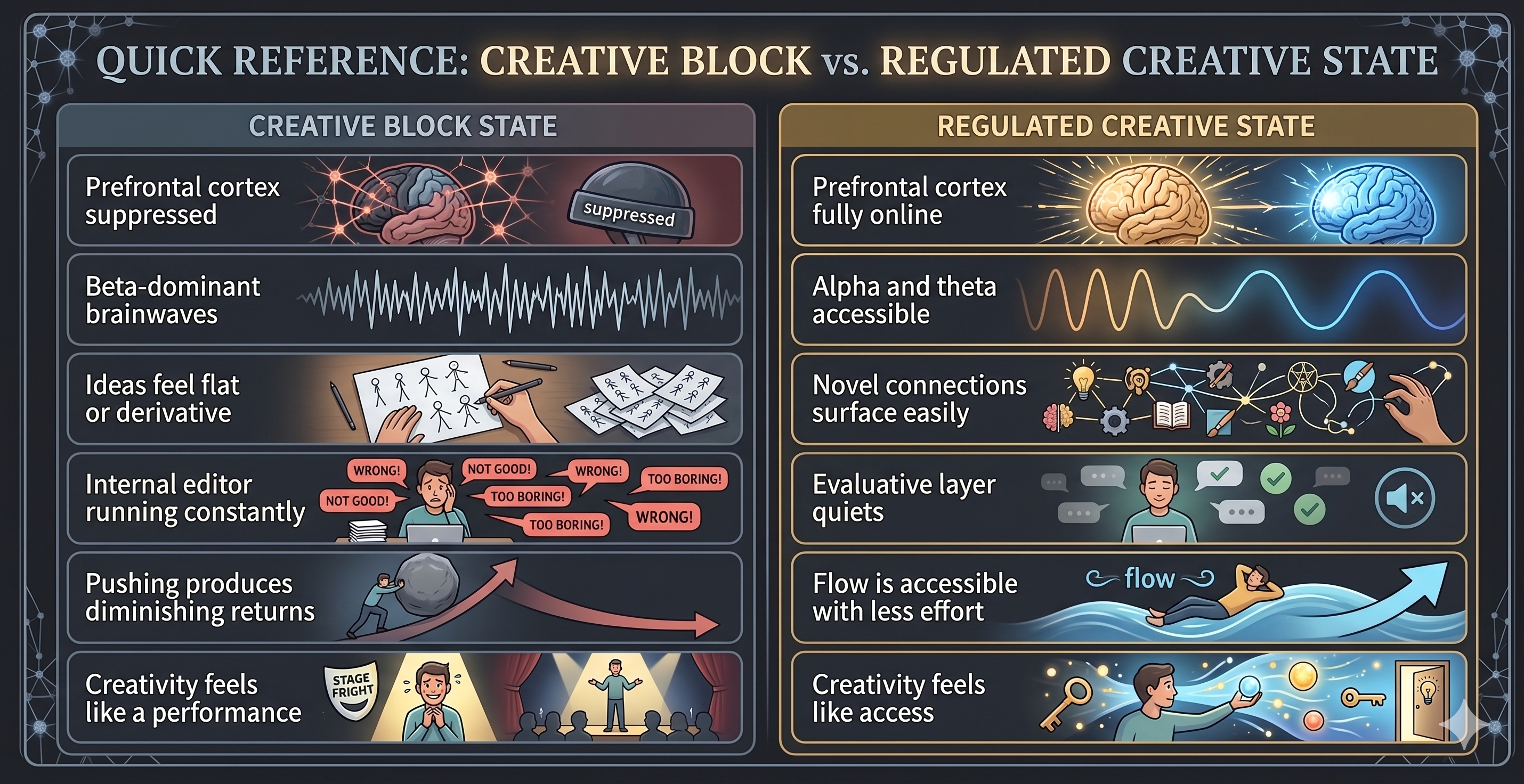
Under stress, the brain operates in a survival hierarchy. The prefrontal cortex — the seat of creative thinking, imaginative leaping, novel association-making, and original perspective — takes a physiological back seat to the faster, more reactive structures that are scanning the environment for threat.
This is not a character flaw. It is an evolutionary feature. The brain that is trying to keep you alive does not prioritize making interesting things. It prioritizes detecting danger and generating rapid, familiar responses.
The result, for high performers, is a specific and recognizable experience: sitting in front of a blank page for an hour and producing nothing. Ideas that feel flat or derivative. Creative work that used to feel energizing now feeling like effort. The sense that something that used to flow has been replaced by a kind of internal resistance that no amount of pushing seems to break through.
Your brain is not broken. It is protecting you. But protection mode and creative mode cannot fully coexist.
Why Does Creative Block Persist Even When Stress Decreases?
Chronic stress creates lasting neurological patterns. The brain's threat-detection pathways, strengthened through repeated activation, remain sensitized even when the immediate stressor has passed. This is why creative block often persists through vacations, weekends, and "recovery" periods — the nervous system is still running the same program, even in a calmer environment.
Lasting creative restoration requires more than the absence of stress. It requires active, deliberate nervous system regulation — consistent input that teaches the body and brain that expansion, not just survival, is available.
The Neuroscience of Creative States
What Brainwave State Is Most Creative?
Creativity is most accessible in alpha and theta brainwave states. Alpha waves (8–12 Hz) are associated with relaxed alertness — the state where ideas surface easily, where disparate things connect, where the mind is both present and expansive. Theta waves (4–8 Hz) are deeper: the territory of dreams, visions, and the kind of non-linear insight that cannot be forced or manufactured.
Beta waves (13–30 Hz) dominate during daily performance and stress. This is the brainwave state most high performers live in. It is excellent for execution and analysis. It is the least generative state for original creative work.
Conscious breathwork, when combined with music, reliably shifts the brain from beta into alpha and theta states. This is not metaphorical. It is a measurable neurological transition — the same state that meditators spend years learning to access, arrived at through the breath in a fraction of the time.
What Is the Role of the Prefrontal Cortex in Creativity?
The prefrontal cortex governs executive function, abstract thinking, and the ability to hold multiple ideas simultaneously — all foundational to creative work. It is also the first region to be downregulated under stress. Regulation practices that reduce sympathetic nervous system activation directly restore prefrontal cortex function. This is why people consistently report not just feeling better after breathwork, but thinking differently — with more fluidity, more connection between ideas, more access to original perspective.
How Conscious Breathwork Restores Creative Access
In a full conscious breathwork session, several things happen simultaneously that directly address the neurological conditions for creative block:
Brainwave entrainment. Rhythmic breathing patterns synchronized to music shift the brain from beta into alpha and theta. The critical, evaluating layer of the mind — the internal editor that kills ideas before they're fully formed — quiets. What was being filtered begins to surface.
Prefrontal cortex restoration. As sympathetic activation decreases through regulated breathing, the prefrontal cortex comes back online. The capacity for novel association, for holding complexity, for genuine creative thinking — all of it returns as the threat-detection noise reduces.
Somatic release of held tension. Creative block often has a somatic component — emotional material, unprocessed experience, or held tension that occupies the body's bandwidth and leaves less available for generative work. Breathwork creates conditions for that material to move and release through the body, not just be managed by the mind.
Access to subconscious imagery. In alpha and theta states, the subconscious — where much of the raw material of creativity actually lives — becomes more accessible. Ideas surface that the analytical mind would filter out in a beta state. Connections form between things that seem unrelated from the surface. Many people experience their most clarifying creative insights during or immediately following a breathwork session.
What I Experienced in My First Breathwork Session
The first time I completed a full guided breathwork session, something happened that I still find difficult to fully describe.
Vivid, clarifying images surfaced — not from conscious effort, but from somewhere beneath the analytical layer I'd been operating from. Images of what my life could actually be. Of creative directions I'd been managing down for years because they didn't fit the reasonable version of what I was supposed to do.
It wasn't a hallucination. It was clarity — the kind that only comes when the noise gets quiet enough to hear what was always there.
That session changed the trajectory of everything that followed. Not because it gave me new ideas, but because it gave me access to what I already knew and had been too stressed, too activated, too defended to reach.
This is what becomes available when the nervous system supports creative work instead of suppressing it.
6 Regulation-Based Practices for Restoring Creative Flow
These are not creativity tips. They are nervous system practices that restore the biological conditions creativity requires.
1. Regulate Before You Create
Before sitting down with creative work, spend 5–10 minutes in a breath practice — even something as simple as box breathing (4 counts in, 4 hold, 4 out, 4 hold). You are not warming up your ideas. You are warming up your nervous system. The difference in what you access will be noticeable within a week of consistent practice.
2. Use the Body to Break Mental Loops
When stuck, the instinct is to think harder. Try the opposite. Stand up. Move. Put on music and let your body lead for a few minutes — ecstatic dance, a walk, free movement. Physical, non-goal-directed movement disrupts stuck neural patterns in ways that more thinking cannot. Ideas frequently surface during movement, not after it.
3. Use Full Breathwork Sessions for Vision Access
A 5-minute breath technique and a full 60-minute conscious breathwork session operate at different depths. The full session is where subconscious imagery, deep creative clarity, and the kind of vision that reorganizes your creative direction actually lives. This is the difference between managing the surface and changing the underlying state.
4. Let Sound Move What Thinking Cannot
Sound healing works directly on the nervous system's stored tension — the somatic holding patterns that occupy bandwidth and reduce creative availability. Creating space in the body through frequency creates space for expression and original thought.
5. Prioritize Genuine Rest
The synthesis phase of creativity — where disparate ideas become cohesive — happens during rest, not during effort. Sleep, genuine stillness, and unstructured time are not breaks from the creative process. They are part of it. Your best ideas will most often arrive just after you have stopped forcing them.
6. Create From Regulation, Not Depletion
Sustainable creative output requires producing from a state where you actually have full access to your capacity. That requires ongoing nervous system maintenance — breathwork, movement, rest, community — not just occasional recovery from burnout. The most prolific, most original creative work comes from regulated people, not depleted ones pushing through.
What Becomes Possible When the Nervous System Supports Creativity
When the nervous system is consistently regulated, creativity stops feeling like something you have to chase and starts feeling like something you can access. Ideas come. Connections happen. The internal editor quiets enough for original work to surface. You stop white-knuckling your way through creative projects and start moving with them.
This is what sustainable creative performance actually looks like — not pushing until you break and recovering, but building the internal conditions for generative work to emerge consistently.
Your creativity was never the problem. The state you have been trying to create from was.
Experience the Shift
Super Sunday is EOC's monthly online conscious breathwork gathering — one hour, first Sunday of every month. A complete session where the brainwave shifts, somatic release, and subconscious access described in this post are directly experienced, not just described.
Frequency Social Club is EOC's monthly in-person gathering in Central Texas — breathwork, education, community, and a live DJ. The in-person container adds movement and sound to the full regulatory arc.
BIG VISION is EOC's annual membership for high performers building consistent regulation practice — conscious breathwork, sound healing, ecstatic dance, A Course in Miracles, and full community support.
Quick Reference: Creative Block vs. Regulated Creative State
Energy of Creation is a 508(c)(1)(a) nonprofit wellness community based in Temple/Belton, Central Texas. Our mission: Breaking Cycles, Building Futures.


