

What Is Hidden Stress — And Can Conscious Breathwork Actually Fix It?
By Destinē The Leader | Energy of Creation
Hidden stress is chronic nervous system activation that persists below conscious awareness — often unrecognized because it has been present long enough to feel normal. Symptoms include jaw tension, shallow breathing, emotional fatigue, and a persistent sense of being "fine" that masks ongoing physiological stress. Conscious breathwork directly addresses hidden stress by signaling safety to the nervous system through rhythmic breathing patterns, reducing cortisol, and restoring the body's natural rest-and-recover state.
What Does Hidden Stress Actually Feel Like?
You know the answer without thinking.
Someone asks how you're doing and you say: "Fine. Busy, but fine."
And you mean it — sort of. Nothing is technically wrong. You're still showing up, still delivering, still checking boxes. But underneath the motion, something feels off.
Your jaw has been tight all day. Your shoulders are somewhere near your ears and have been since Tuesday. You realize — only right now, reading this — that you've been holding your belly in for hours. And you can't remember the last time you took a full breath. A real one. The kind that goes all the way down.
That's hidden stress. Not dramatic. Not a crisis. Just a chronic physiological state that has been present long enough to feel like personality.
Most high performers I work with have a version of this story. The details change. The pattern doesn't.
And here's what matters most: this isn't a discipline problem, a mindset problem, or a willpower problem. It's a biology problem. And biology responds to specific tools.
Conscious breathwork is one of the most direct ones available.
Why Does Stress Hide in the Body?
Stress is not primarily a mental experience — it is a full-body physiological event. Here's what actually happens:
You encounter a stressor — a hard conversation, a packed schedule, an email that lands wrong. Your body releases adrenaline and cortisol. Muscles tighten. Breathing becomes shallow and chest-led. Heart rate increases. The nervous system activates its protect mode.
Then the stressor ends. But for most high performers, the body never fully receives the signal that it's safe to come down.
The muscles stay braced. The breath stays restricted. Cortisol doesn't fully clear. The protective state becomes the resting state.
Over time, this pattern produces:
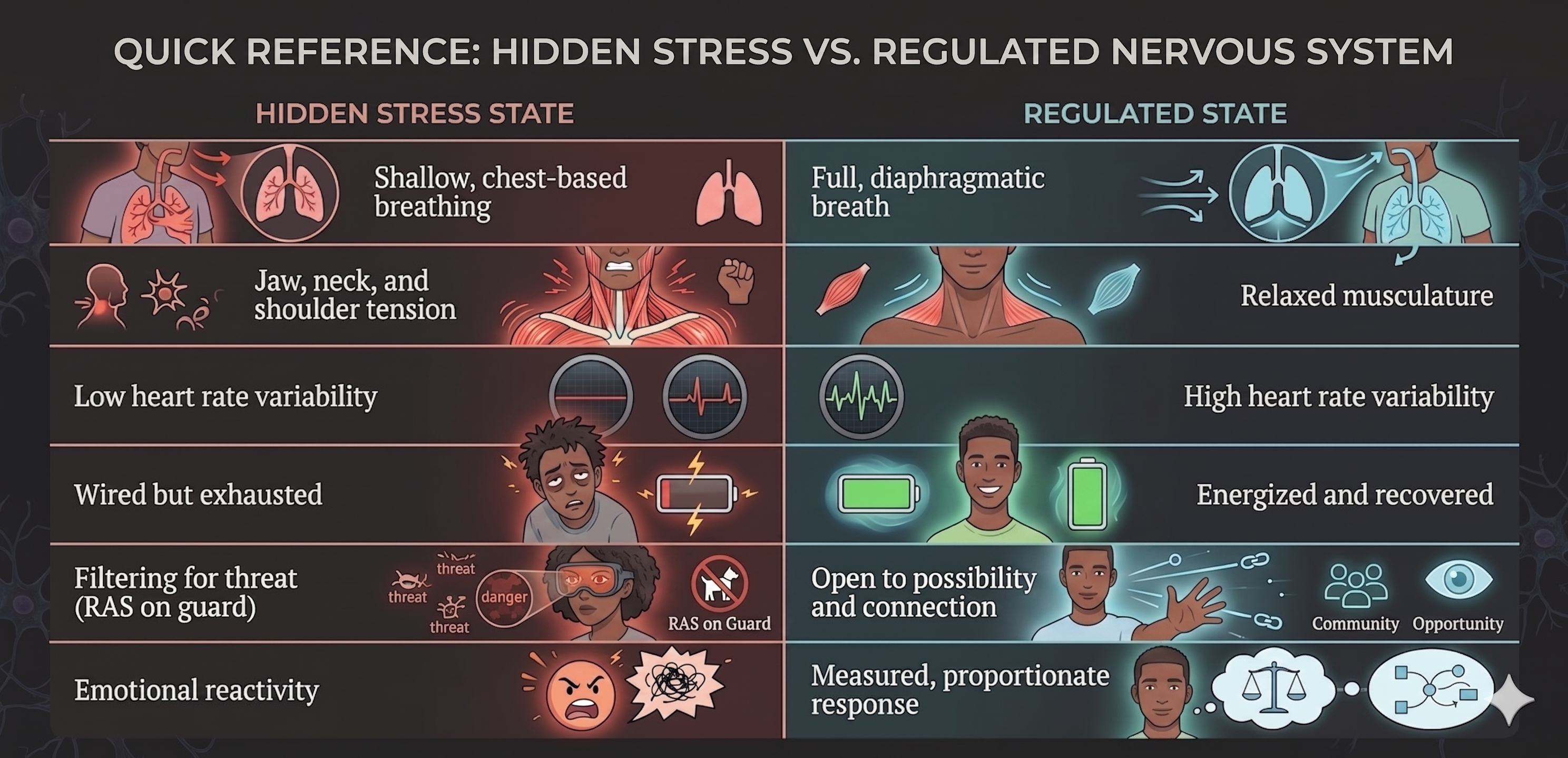
Chronic physical tension — tight jaw, stiff neck, persistent upper back pain
Restricted breathing — shallow, chest-based breaths that perpetuate the stress cycle
Emotional fatigue — the wired-but-exhausted feeling that doesn't resolve with sleep
Cognitive fog — reduced clarity, slower decision-making, difficulty being present
You cannot think your way out of a pattern that lives in the body. The nervous system doesn't respond to affirmations. It responds to felt, physical experience — and it needs direct physiological input to change course.
That's what conscious breathwork provides.
What Is Conscious Breathwork?
Conscious breathwork is the intentional, structured use of breathing patterns to directly regulate the autonomic nervous system. Unlike casual deep breathing, conscious breathwork uses specific rhythms, ratios, and retention phases that create measurable physiological shifts in real time.
At Energy of Creation, the breathwork practice is rooted in ancient pranayama — the breathing tradition at the core of yogic and Ayurvedic medicine — and grounded in modern science of oxygenation, CO₂ balance, and nitric oxide production.
In a session, rhythmic breathing patterns set to music guide the nervous system from sympathetic activation (fight-or-flight) into parasympathetic regulation (rest-and-digest). The music provides a neurological anchor. The rhythm does the work. The cumulative effect creates shifts that are not subtle once you've felt them.
How Does Conscious Breathwork Reduce Stress? The Science.
Does Breathwork Reset the Nervous System?
Yes — measurably. Slow, rhythmic breathing patterns increase heart rate variability (HRV), a primary biomarker of nervous system resilience. Higher HRV indicates the ability to handle demands without tipping into overdrive and recover quickly when stress occurs. Chronic stress is consistently associated with low HRV. Conscious breathwork moves HRV in the opposite direction.
What Does Nitric Oxide Have to Do With Breathwork?
Breath retention phases in conscious breathwork sessions increase nitric oxide production in the bloodstream. Nitric oxide improves circulation, enhances cognitive clarity, and supports immune function. This is a vascular and neurological response, not a metaphorical one — and it's one reason breathwork practitioners consistently report improved focus and energy following sessions.
What Is CO₂ Tolerance and Why Does It Matter for Stress?
Carbon dioxide is commonly misunderstood as harmful, but it is essential to oxygen delivery — CO₂ is what signals the body to release oxygen from red blood cells into the tissues. Conscious breathwork builds CO₂ tolerance, training the body to use oxygen more efficiently. Improved CO₂ tolerance is associated with greater physical endurance and a calmer physiological baseline under stress.
How Does Breathwork Change Brainwaves?
Music combined with rhythmic breathing entrains the brain from fast beta frequencies — the state of daily performance and stress reactivity — into slower alpha and theta states. These are the same brainwave states associated with deep meditation, creative flow, and genuine rest. The shift is not forced. It's arrived at through the breath.
What Does a First Conscious Breathwork Session Feel Like?
The first time I did a full guided session, I went in skeptical. I'd done work on myself. I'd tried different modalities. I was still carrying something I couldn't quite name.
By the end of that session, tears were running down my face — not from sadness, but from relief. The kind of release that only happens when you've been holding something for so long you forgot you were holding it.
Vivid images surfaced of what my life could look like. Of who I already was underneath years of accumulated tension and performance. Something woke up. Something I had shoved down.
That was the beginning of me being free again.
Not a metaphor. A somatic shift — felt in the body, not just described by the mind.
Who Benefits Most From Conscious Breathwork for Stress?
Conscious breathwork is beneficial for most healthy adults. It tends to be especially significant for:
High performers in chronic "go" mode who have normalized stress as a productivity requirement
People for whom traditional meditation hasn't worked — breathwork doesn't require the mind to cooperate first
Those carrying systemic and chronic stress — including BIPOC, Queer, and Neurodivergent individuals navigating compounding environmental stressors
Trauma survivors who find talk-based therapies exhausting or insufficient on their own
Anyone who has tried to think their way out of a physical stress pattern and found that approach has limits
How to Try Conscious Breathwork at Energy of Creation
Super Sunday is EOC's monthly online conscious breathwork gathering — the first Sunday of every month, one hour. It's a complete session, not a preview, and community energy amplifies the physiological effects in ways that solo practice cannot replicate.
Frequency Social Club is EOC's monthly in-person gathering in Central Texas — three hours including education, a full breathwork session, and a social hour with a live DJ.
BIG VISION is EOC's annual membership for high performers building a consistent regulation practice — breathwork, sound healing, A Course in Miracles, embodied movement, and full community access.
Quick Reference: Hidden Stress vs. Regulated Nervous System
Energy of Creation is a 508(c)(1)(a) nonprofit wellness community based in Temple/Belton, Central Texas. Our mission: Breaking Cycles, Building Futures.


