
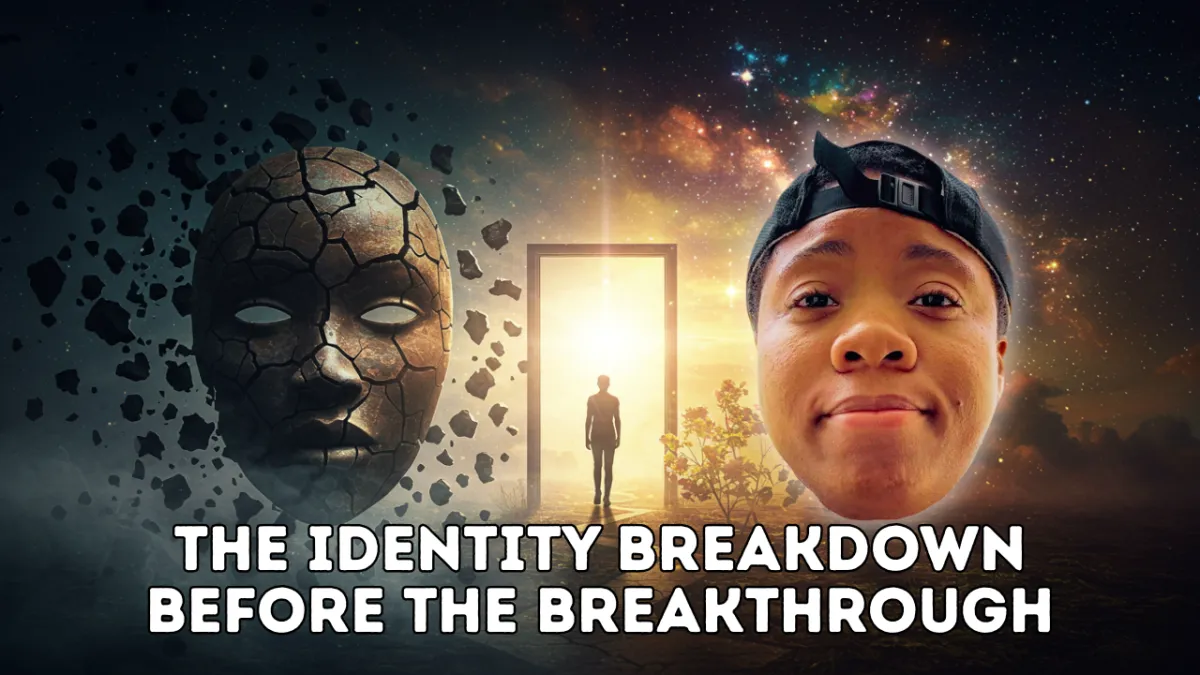
What Is an Identity Breakdown — And Is It Actually Part of Transformation?
By Destinē The Leader | Energy of Creation
An identity breakdown is the disorienting in-between phase of genuine personal transformation — the period when an old version of the self has dissolved but a new one has not yet fully consolidated. It is characterized by a loss of familiar reference points, emotional volatility, reduced productivity, and the unsettling sense of not recognizing yourself. Far from signaling failure, an identity breakdown is a documented stage of psychological growth — the structural precursor to meaningful, lasting change. Understanding what is happening during this phase — and having the right somatic tools to move through it — is the difference between the in-between feeling like a crisis and feeling like a passage.
What Does an Identity Breakdown Feel Like?
The 3am wake-ups. The low-grade grief you can't quite name. The creeping question — what is wrong with me? — that shows up alongside the morning coffee.
You've done the work. You've made the changes. You've walked away from things that weren't serving you, leaned into things that felt true, said yes to a version of yourself that felt closer to who you actually are.
And then you wake up one morning and feel nothing familiar.
The things you used to love don't land the same way. The people who have always felt like home now feel slightly foreign. The old version of you is clearly gone. The new one hasn't fully arrived.
This is the in-between. And it is one of the most disorienting, underacknowledged experiences in any real transformation process.
If you're in it right now: this is not a breakdown. This is a reorganization.
Why Does Transformation Feel Like Falling Apart?
What Happens Psychologically During an Identity Shift?
During genuine personal transformation, the psychological structures that organized a previous identity — the beliefs, roles, relationships, habits, and self-concepts that made life coherent — are actively being dismantled and rebuilt. This process does not happen instantaneously. The old structure dissolves faster than the new one forms, creating a period of genuine structural gap.
Psychologists describe this as a liminal state — a threshold phase between what was and what will be. It is temporary by nature. It is not permanent by nature. And it is not evidence that something has gone wrong.
What makes it feel so destabilizing for high performers specifically is that it arrives with a significant reduction in the competence and output they typically rely on to feel safe. You're not producing the way you used to. The clarity that usually drives your decisions isn't there. The identity labels that gave you social legibility — professional, partner, achiever — feel ill-fitting.
Because no one normalizes this phase, most people interpret it as failure. It is not failure. It is the cocoon stage — and the cocoon is not a malfunction.
Why Do Old Relationships Feel Different During Transformation?
When your identity shifts, your relational field shifts with it. The people, dynamics, and environments that were calibrated to your previous version may no longer feel like a match — not because anything is wrong with those relationships, but because the person showing up to them has genuinely changed. This relational dissonance is one of the most painful and least discussed aspects of real growth.
What Is Actually Happening During an Identity Breakdown?
Identity breakdowns follow recognizable patterns. Here is what is typically occurring beneath the surface:
Intuition intensifies. The inner knowing that has been overridden or managed begins to surface with real insistence. What feels like heightened intuition is partly the reduction of the ego's noise — when the old structure loosens, the quieter signal becomes more audible.
Old patterns lose their grip. Behaviors, coping mechanisms, and relational dynamics that once felt stable begin to feel too small. This is not regression. It is outgrowing — which is exactly what transformation requires.
New edges form. Boundaries that couldn't be articulated before begin to become non-negotiable. Not because the person has become difficult, but because they have become more honest about what is actually sustainable for them.
The body signals before the mind catches up. Physical symptoms — fatigue, disrupted sleep, changes in appetite, somatic restlessness — often precede cognitive clarity about what is shifting. The body knows the transition is happening before the mind has language for it.
This is initiation territory. Not punishment. Not regression. The kind of structural dissolution that has always preceded structural renewal.
How to Move Through an Identity Breakdown Without Losing the Thread
What Helps During an Identity Crisis?
The most important reframe is this: the goal during an identity breakdown is not to resolve it faster. The goal is to stay in honest relationship with yourself while the reorganization happens.
Stop trying to produce your way through it. The pressure to return to full output — to have the answers, to perform clarity you don't yet have — will slow this process, not accelerate it. This is one season in a longer arc. Forcing productivity from an identity that is mid-dissolution is like trying to run a race in shoes that are actively disintegrating.
Write it down, even when it doesn't make sense. Thoughts during this season feel like noise. Write them anyway. Patterns surface on the page that cannot surface in the mind. You don't need to understand what you're writing. The act of externalizing it interrupts the loop.
Anchor into the body. This is the most important practical guidance in this entire post. When the mind is structurally unstable — when the identity that organized your thoughts is in active dissolution — the body is the most reliable ground available.
How Does Somatic Practice Help During Transformation?
The nervous system cannot distinguish between the threat of a predator and the threat of becoming someone new. Both activate the same stress response. Which means that during an identity breakdown, the nervous system is often running at elevated activation — making everything feel more threatening, more urgent, and more permanent than it actually is.
Somatic practices — practices that work through the body rather than around it — directly address this activation:
Conscious breathwork is the most direct tool available for nervous system regulation during periods of identity transition. It bypasses the analytical mind entirely and works at the physiological level — helping the body remember what safety feels like even when the identity is mid-reorganization. In a full session, what has been held in the body during the transition often surfaces and releases — not through analysis, but through the breath.
Sound healing gives emotional material that has been accumulating during the transition somewhere to move. Frequency works on the body's tissue directly, releasing held tension that the mind's ongoing reorganization keeps generating.
Ecstatic dance and embodied movement interrupt the somatic patterns that the old identity encoded in the body — posture, tension, movement habit — and create new physical experience that supports the emerging self.
How Long Does an Identity Breakdown Last?
There is no fixed timeline. Identity breakdowns last as long as the reorganization requires — which is influenced by the depth of the shift, the quality of support available, and the degree to which somatic and psychological tools are being used consistently.
What is consistent across this experience is that it is temporary. The disorientation is a phase, not a permanent state. And the practices described above do not just make the phase more bearable — they actively accelerate the consolidation of what is emerging.
What Comes After the Identity Breakdown?
What comes after is not a return to the previous self. That version has genuinely dissolved. What comes after is the consolidated new identity — more honest, more aligned, more capable of holding what you are actually here to do.
The confusion, the grief, the strange silence where your old certainty used to be — it was making room. Not just for new goals or new circumstances. For a version of you with more internal capacity, more alignment, more genuine access to what matters.
Your breakthrough is not despite this breakdown. It is because of it.
Support for the In-Between
If you are in this season — in the middle of the reorganization, trying to hold the thread — you do not have to navigate it alone.
Super Sunday is EOC's monthly online conscious breathwork gathering — one hour, first Sunday of every month. A complete session designed to give your nervous system direct experience of what regulation feels like during a season that can otherwise feel entirely destabilizing.
Frequency Social Club is EOC's monthly in-person gathering in Central Texas. Being in community with others who are in their own versions of this process is one of the most powerful regulatory inputs available during an identity transition.
BIG VISION is EOC's annual membership for high performers building the practices, the community, and the internal infrastructure to move through seasons like this with more capacity and less chaos.
Quick Reference: Identity Breakdown vs. Identity Consolidation
Identity Breakdown Phase Identity Consolidation Phase Familiar things feel foreign New preferences and values clarify Reduced productivity and drive Restored energy with new direction Grief, loss, disorientation Increasing clarity and groundedness Old patterns feel too small New boundaries feel natural Relationships feel misaligned Deeper, more honest connections form Nervous system in elevated activation Nervous system finds new baseline
Energy of Creation is a 508(c)(1)(a) nonprofit wellness community based in Temple/Belton, Central Texas. Our mission: Breaking Cycles, Building Futures.