How to Reconnect With Your Creative Self — Why High Achievers Lose Creativity and How to Reclaim It
By Destinē The Leader | Energy of Creation
High achievers lose connection with their creative self not through lack of talent or interest, but through a series of reasonable professional and social trades — prioritizing productivity, measurability, and output over expression, exploration, and play. Over time, the internal conditions that make creativity possible — psychological safety, somatic availability, freedom from constant self-evaluation — are systematically dismantled. Reclaiming creativity is not a matter of scheduling creative time or finding the right technique. It is an embodied process of rebuilding the internal conditions under which the expressive self can exist again. Conscious breathwork, ecstatic dance, sound healing, and community are among the most direct tools for that rebuilding because they work somatically — at the level where creative suppression is actually stored.
Why Do High Achievers Lose Their Creativity?
There is a specific kind of grief that does not get named very often.
It is not the grief of losing someone. It is not the grief of a door closing. It is quieter than that, and it tends to live underneath a life that looks, by most measures, successful.
It is the grief of the creative self you set aside.
Maybe it was music. Or writing. Or movement. Or the way you used to think — freely, laterally, without the constant weight of practicality pressing down on every idea. At some point, you made a series of reasonable decisions. You got serious. You got responsible. You got productive. You built something real.
And somewhere in that process, the part of you that made things for the pure aliveness of it went quiet.
Not gone. Quiet. There is a difference. And if you have ever felt a sudden, inexplicable pang when you see someone performing, or painting, or moving freely, or creating something that has no purpose beyond its own existence — you already know the difference.
That pang is the creative self, still present, still wanting, still waiting.
What Makes High Performers Suppress Their Creative Self?
The people who come to EOC's work are extraordinarily good at achieving. They have built the skill of output, delivery, and execution. They know how to produce results.
But somewhere in developing that skill, most of them learned — implicitly, through the feedback loops of professional and social life — that creativity is a luxury. That it is indulgent. That it is fine as a hobby but not serious. That the responsible thing is to be productive, measurable, and efficient.
So they made themselves smaller in that particular direction. They learned to evaluate ideas before they were fully formed. To self-edit before they even began. To require a clear purpose before allowing themselves to explore.
Over time, the creative channel became so cluttered with judgment and practicality that even sitting down to make something felt impossible. Not because creativity was gone, but because the internal conditions for it had been systematically dismantled.
This is not a character flaw. It is a survival adaptation. And it does not have to be permanent.
Why Creativity Cannot Be Reclaimed Through Scheduling Alone
Why Don't Creativity Tips Work for High Achievers?
Most creativity advice — schedule creative time, try a new hobby, embrace constraints, daydream more — is offered as though the barrier is informational. As though knowing a technique is what is missing.
For high achievers, the barrier is not informational. It is relational and somatic.
The relationship with the creative self was interrupted. That relationship has to be rebuilt — not through tips, but through experience. Through showing up repeatedly in contexts where the productive, managed self can stand down and the expressive self has room to exist.
And that rebuilding happens in the body before it happens in the mind.
The internal self-monitoring that most high performers run constantly — evaluating, qualifying, assessing output for adequacy — is a somatic pattern as much as a mental one. It lives in the body's held tension, in the restricted breath, in the posture of someone perpetually prepared to be assessed. Until those somatic patterns shift, the creative self remains managed rather than free.
What Is the Somatic Root of Creative Block?
Chronic performance pressure encodes itself in the body as persistent tension, restricted breathing patterns, and a nervous system in sustained activation. These somatic conditions are the physiological opposite of what creativity requires.
Creative states — alpha and theta brainwaves, prefrontal cortex engagement, free associative thinking — are accessible primarily in states of physiological safety and relaxation. When the body is running a chronic stress program, the nervous system does not generate those states, regardless of how much the conscious mind wants to create.
Reclaiming creativity therefore requires reclaiming the body state that creativity lives in — which is exactly what somatic practice addresses.
How EOC Practices Rebuild Creative Capacity
How Does Conscious Breathwork Restore Creativity?
A full conscious breathwork session asks you to do something that the high-achieving, self-managing self rarely does: surrender to something the analytical mind cannot control. The rhythm, the music, the breath itself — it is not a productivity exercise. It is an invitation to exist without producing. To feel without evaluating. To be present with your own inner experience without immediately converting it into something useful.
For high performers, this is often the most foreign and most powerful experience they encounter. The internal editor that has been running constantly quiets. The self-monitoring drops. And what surfaces in that space — imagery, emotion, creative impulse, clarity about what actually wants to be made — tends to be some of the most generative material they have encountered.
My own first session produced exactly this. I went in with my analytical mind fully engaged. And what surfaced were vivid, clarifying images of what my life could actually be — not the reasonable version, not the scaled-back version, but the honest one. The version the ego had been managing down for years.
That session led to Ibiza. To Rishikesh. To Bali, where I trained in ecstatic dance facilitation — not because I had a business plan for it, but because something had reopened that knew the next true thing. That is what creative reclamation looks like when the internal conditions actually shift.
What Is Ecstatic Dance and How Does It Support Creativity?
Ecstatic dance is free-form, non-choreographed movement — typically guided by music, in a community setting, without structured steps or performance expectations. It is one of the most direct re-entry points into creative embodiment available.
You cannot ecstatically dance and simultaneously maintain the professional self-management most high performers run constantly. The body takes over. The managed self steps back. And in that space — in the freedom of movement that has no audience and no evaluation — something creative and alive that has been carefully managed begins to breathe again.
The effect extends beyond the dance floor. Every time the managed self is voluntarily set aside in favor of genuine, embodied expression, the nervous system's sense of what is safe to express expands. Creative freedom in movement creates neurological pathways that support creative freedom in work, relationships, and life.
How Does Sound Healing Support Creative Reclamation?
Before the mind decides what is worth expressing, the body feels it. Sound healing works directly at the somatic level — the level where creative impulse actually originates, before it is filtered through evaluation and practicality.
Frequency-based practices release held tension in the body's tissue — the chronic holding patterns that high-performance culture generates and that occupy the body's bandwidth. What those patterns have been suppressing, including creative energy, becomes available as they release. Creating space in the body through sound is creating space for expression.
How Does Community Support Creative Reclamation?
One of the quietest forms of creative suppression is isolation — the sense of being the only one who feels the pull toward something more expressive, more alive, more whole. That isolation is itself a nervous system signal: creativity feels dangerous because no one around you seems to be doing it.
Being in community with people who are also doing this work — who are also reclaiming the parts of themselves that productivity required them to set aside — is regulatory in a way that nothing else quite replicates. The nervous system receives new information: this is normal here. Expression is safe here. You are not alone in the wanting.
And that information makes it safer to reach.
What Does Creative Reclamation Actually Produce?
What Comes Back When Creativity Is Reclaimed?
What gets reclaimed is genuinely different for each person. For some it is a literal return to a creative practice — music, writing, visual art, movement. For others it is something more diffuse but equally real: a quality of thinking that becomes more fluid and original. A way of moving through work and life that has more play in it. A relationship with themselves that has more honesty and less performance.
What is consistent is this: the part of you that makes things — that sees connections, that has an original perspective, that generates rather than just executes — is not optional. It is not a luxury for when the real work is done. It is part of the real work.
When it is suppressed over time, everything else costs more. The productivity traded for the creativity starts to hollow out.
Reclaiming it does not make you less capable. It makes you more whole. And whole people create differently than depleted ones.
Begin the Reclamation
Super Sunday is EOC's monthly online conscious breathwork gathering — one hour, first Sunday of every month. A complete session where the internal conditions for creative reclamation — regulated nervous system, quieted internal editor, access to subconscious imagery — are directly experienced.
BIG VISION is EOC's annual membership for high performers building the full somatic and spiritual foundation — conscious breathwork, sound healing, ecstatic dance, A Course in Miracles, and a community of people reclaiming the wholeness that performance culture asked them to set aside.
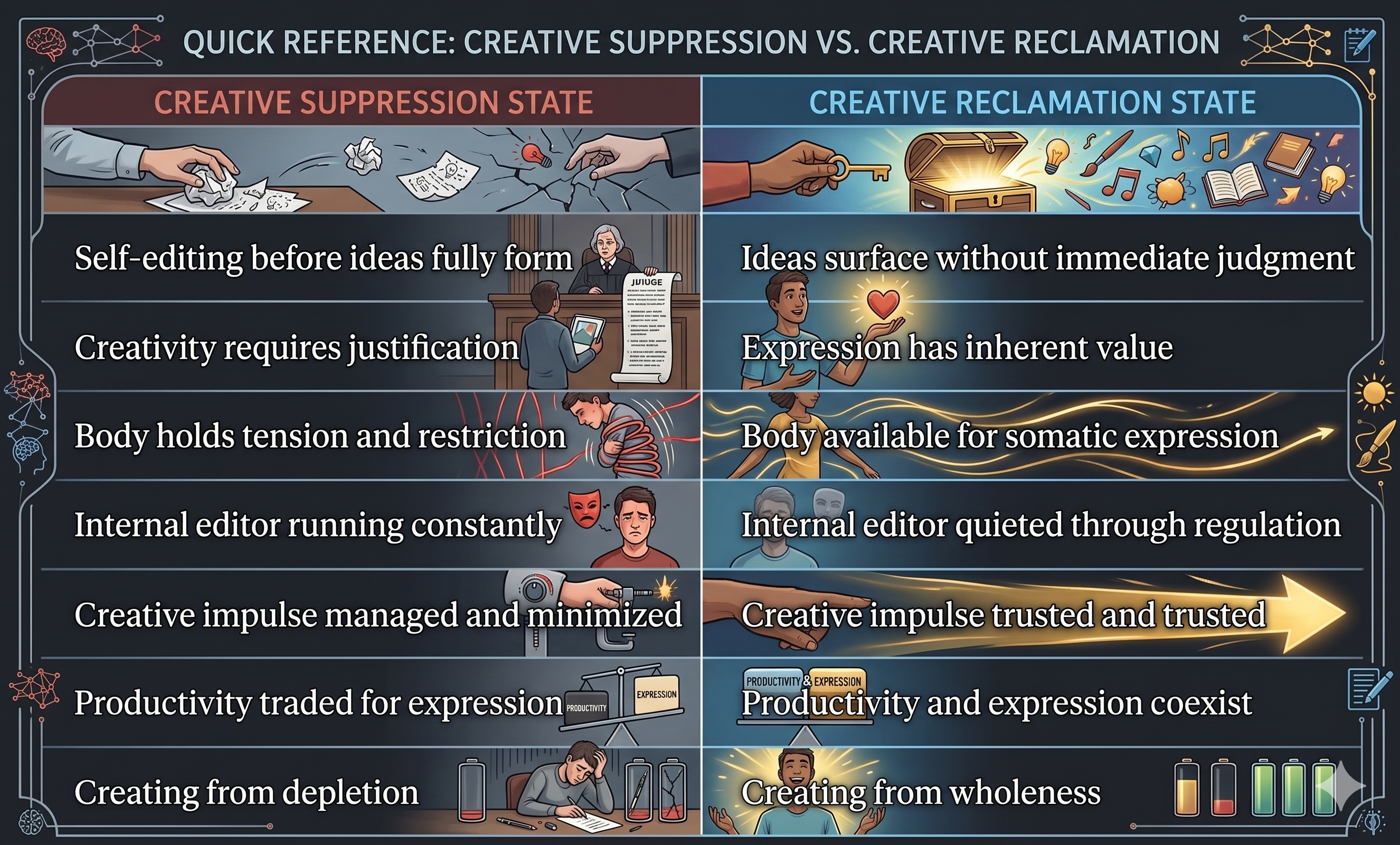
Quick Reference: Creative Suppression vs. Creative Reclamation
Energy of Creation is a 508(c)(1)(a) nonprofit wellness community based in Temple/Belton, Central Texas. Our mission: Breaking Cycles, Building Futures.


