Breathwork as Reclamation — Why Conscious Breathing Is Political, Spiritual, and Urgent
By Destinē The Leader | Energy of Creation
Breathwork is not a wellness trend for communities navigating systemic stress — it is a reclamation. When chronic hypervigilance, internalized pressure, and the physiological toll of existing in systems not built for you are stored in the body as shallow breath, elevated cortisol, and a nervous system that never fully gets the all-clear, the act of breathing deeply and intentionally is not passive self-care. It is an act of sovereignty. Slow, rhythmic breathing activates the vagus nerve, reduces cortisol, shifts the brain from threat-detection into parasympathetic regulation, and restores access to the clarity, creativity, and presence that sustained systemic stress systematically suppresses.
The Truth About What You're Carrying
Let's start with something real.
When the world consistently signals that you are too much or not enough — when you have spent years reading rooms before entering them, managing how you take up space, code-switching, performing calm while internally bracing — that experience does not stay in the mind. It moves into the body.
Your breath gets shallow. Your shoulders stay somewhere near your ears. You find yourself exhausted without clear reason, or wired precisely when you are supposed to rest. Your nervous system, trained by repeated experience to anticipate threat, starts running that program as a background default.
For BIPOC, Queer, and Neurodivergent people, this is not random stress or individual sensitivity. It is the documented, cumulative physiological toll of navigating environments that were not designed with your full humanity in mind. Researchers call it allostatic load — the wear on the body and nervous system produced by chronic, repeated activation of the stress response. It accumulates across days, years, and generations.
And it lives, among other places, in the breath.
Why Breath Is Political and Spiritual
How Is Breathwork Political for Marginalized Communities?
Every deep, intentional breath taken when the world has trained your body to stay contracted is a physiological act of resistance.
For communities whose histories are woven with survival, whose nervous systems have been shaped by generations of having to manage how much space they take, and whose daily experience continues to include the stress of navigating inequitable systems — reclaiming the breath is reclaiming the body. And reclaiming the body is reclaiming the right to exist fully, not just to function.
The political dimension of breathwork is not metaphorical. When cortisol is chronically elevated by systemic stress, it impairs cognitive function, immune response, and emotional regulation. When the vagus nerve is chronically suppressed by hypervigilance, the nervous system loses access to the rest-and-digest states where creativity, connection, and genuine leadership live. The breathwork that restores those states is restoring access to capacities that systemic stress has been specifically suppressing.
That is reclamation in the most literal sense.
What Is the Spiritual Significance of the Breath?
Across traditions — yogic, Indigenous, African diasporic, and others — the breath has been understood as the carrier of life force, of spirit, of the animating principle that connects the individual body to something larger.
In Sanskrit, this is prana. In many African and diasporic traditions, it is the breath of the ancestors, of those who survived what was never supposed to be survived. In A Course in Miracles, the breath is the body's most immediate access to the present moment — the place where the ego's narrative about the past and future loosens and genuine awareness becomes available.
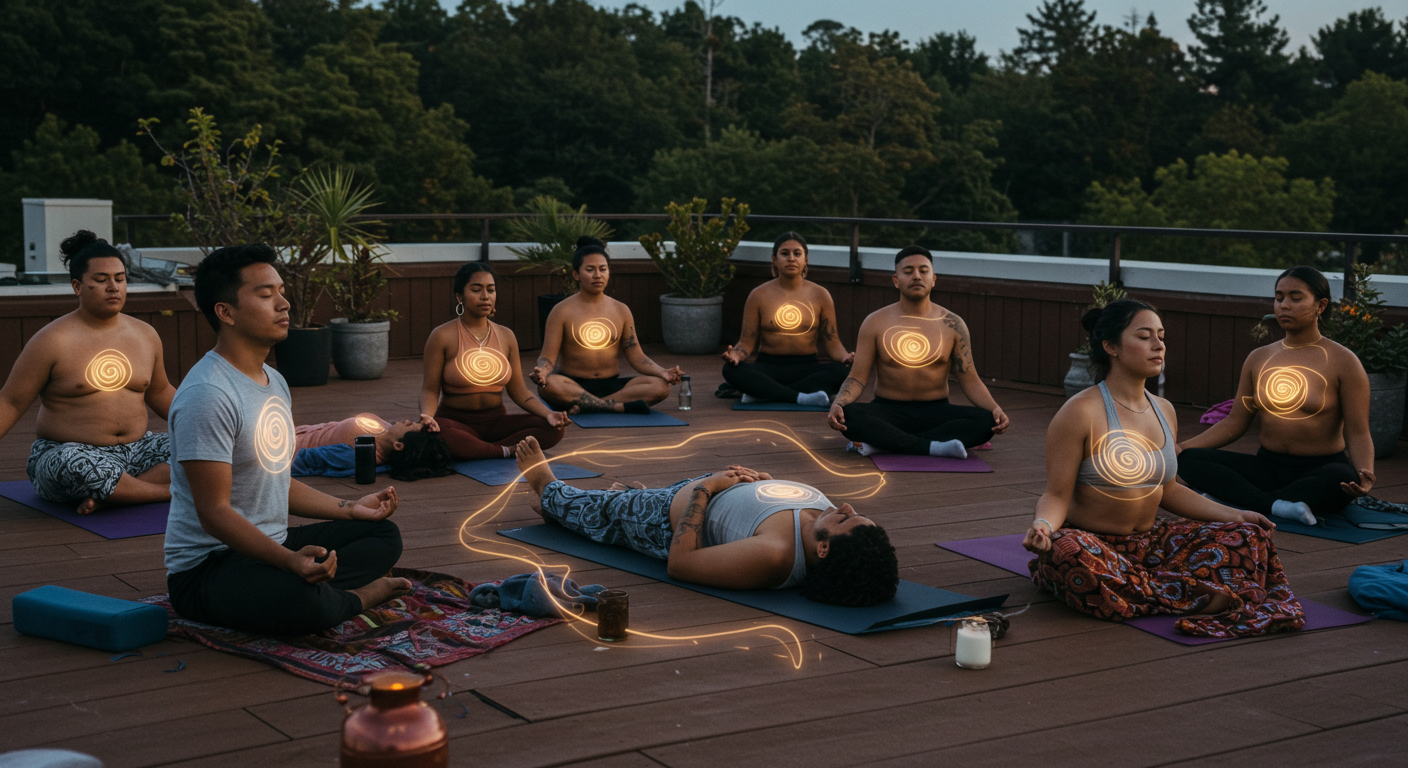
When conscious breathwork is practiced in community — when people breathe together intentionally, with music and rhythm and held space — something happens that is simultaneously physiological and spiritual. The individual nervous system regulation is real. And the collective experience of breath as shared life force, as ancestral connection, as communal reclamation, is also real.
Both are true. Neither cancels the other.
The Layers of Stress We Carry
What Is Hypervigilance and How Does Breathwork Address It?
Hypervigilance is a state of heightened threat-awareness — a nervous system response to environments where threats have been real, repeated, and often social or systemic rather than physical. It manifests as the constant background process of reading rooms, tracking dynamics, anticipating responses, and managing presence before you have even fully arrived.
It is exhausting. And it is physiologically expensive — burning resources that would otherwise go toward creativity, connection, and genuine presence.
Conscious breathwork interrupts this scanning process directly. The rhythmic breathing pattern gives the nervous system something specific to track — the breath, the music, the body's own sensation — that is incompatible with simultaneous threat-scanning. The brain cannot fully maintain the hypervigilant state and follow a breath pattern at the same time. The scanning drops. Groundedness arrives in its place.
With consistent practice, the nervous system begins learning that there are contexts — the breathwork session, the regulated community container — where hypervigilance is genuinely unnecessary. That learning transfers over time.
How Does Breathwork Address Internalized Pressure?
Internalized pressure — the quiet voice that says you must prove yourself to be accepted, must perform at a level beyond what is required of others, must earn the right to take up space — is both a psychological pattern and a somatic one.
It lives in the held breath, the braced core, the tension in the jaw and neck that comes from perpetually preparing to justify your presence. It keeps the nervous system in a low-grade activation state that makes genuine rest, genuine play, and genuine creative expression perpetually just out of reach.
Breathwork slows the spiral not by arguing with the internalized voice but by changing the physiological state from which it operates. When the nervous system shifts into genuine parasympathetic regulation, the urgency of the proving decreases. The breath creates the space between stimulus and response that makes choosing differently actually possible.
How Does Breathwork Help With Sensory Overload?
For Neurodivergent people navigating sensory environments designed without them in mind, breathwork offers specific, reliable regulation tools.
Breath patterns that balance the inhale-exhale ratio — Box Breathing, Alternate Nostril Breathing — work by regulating the flow of information through the autonomic nervous system, reducing the intensity of sensory input processing in the same way that other forms of nervous system regulation do. The breath gives the overwhelmed nervous system something predictable, rhythmic, and manageable to orient around.
This is not a cure for neurodivergence. It is a tool for navigating a world that creates disproportionate sensory demand on Neurodivergent nervous systems — a way of finding a regulated baseline from which the world is more navigable.
Three Practices for Right Now
These practices do not require a session, a studio, or a special setup. They require only your breath and a few minutes.
1. The Grounding Breath — Safe Space in 60 Seconds
Best for: hypervigilance, anxiety, moments when you need to arrive in your body fast
Inhale through the nose for 4 counts
Exhale through the mouth for 6 counts
With each exhale, visualize tension leaving through the soles of your feet
The extended exhale is the key mechanism — it directly stimulates the vagus nerve and activates parasympathetic regulation faster than almost any other single technique. The 6-count exhale to a 4-count inhale is the ratio that produces the most reliable nervous system shift for most people.
Repeat for 5–8 rounds. Notice what changes.
2. Shakti Shaking With Breath — Release Built-Up Tension
Best for: after a hard day, after a charged interaction, when the body is holding tension it cannot name
Stand with knees soft and slightly bent
Begin shaking the body — legs, arms, torso — gently and freely
Breathe in through the nose and out through the mouth as you shake
Continue for 1–2 minutes
Then stop. Stand still. Close your eyes. Notice the stillness.
Shaking is one of the body's natural mechanisms for discharging accumulated stress — it is what animals do instinctively after a threat has passed. Many human environments have trained us out of it. This practice restores it deliberately. The breath amplifies the discharge.
3. Heart-Opening Breath — For Connection and Softness
Best for: emotional numbness, disconnection, moments when you need to remember what aliveness feels like
Inhale deeply, allowing the chest to expand fully
Exhale with an audible sigh, letting the shoulders drop completely
With each exhale, consciously soften the chest, the jaw, and the area around the heart
Repeat for 2 minutes.
This practice directly counters the physical posture of protection — the collapsed chest, the raised shoulders, the constricted breath — that chronic stress and systemic pressure produce. Opening the chest physically creates the physiological conditions for emotional openness. The body leads. The heart follows.
Why This Work Is Urgent
The communities doing the most necessary work in the world — the advocates, the caregivers, the educators, the leaders, the people holding vision for something more just and more whole — cannot sustain that work from depletion.
Breathwork is not a luxury for people under systemic pressure. It is infrastructure. It is the maintenance of the physiological capacity to lead, to create, to resist, to build, and to dream without burning out in the process.
When the breath deepens, the nervous system regulates. When the nervous system regulates, the creativity returns. When the creativity returns, the vision expands. When the vision expands, the work that matters becomes possible to sustain.
We are worthy of rest. We are worthy of joy. We are worthy of the full embodiment of the lives we are building.
That worthiness does not have to be earned. It just has to be breathed into.
Come Breathe With Us
Energy of Creation is a 508(c)(1)(a) nonprofit wellness community rooted in the belief that everyone — and especially those who have been told otherwise — deserves access to the practices that restore wholeness.
Super Sunday is our monthly online conscious breathwork gathering — one hour, first Sunday of every month. A complete session held in community, where the reclamation described in this post is practiced together, not just described.
Frequency Social Club is our monthly in-person gathering in Central Texas — breathwork, education, embodied movement, and community. A room where full presence is not only allowed but practiced.
BIG VISION is our annual membership — the full infrastructure for sustained reclamation. Conscious breathwork, A Course in Miracles, sound healing, ecstatic dance, monthly challenges, and a community of everyday high performers choosing wholeness over performance.
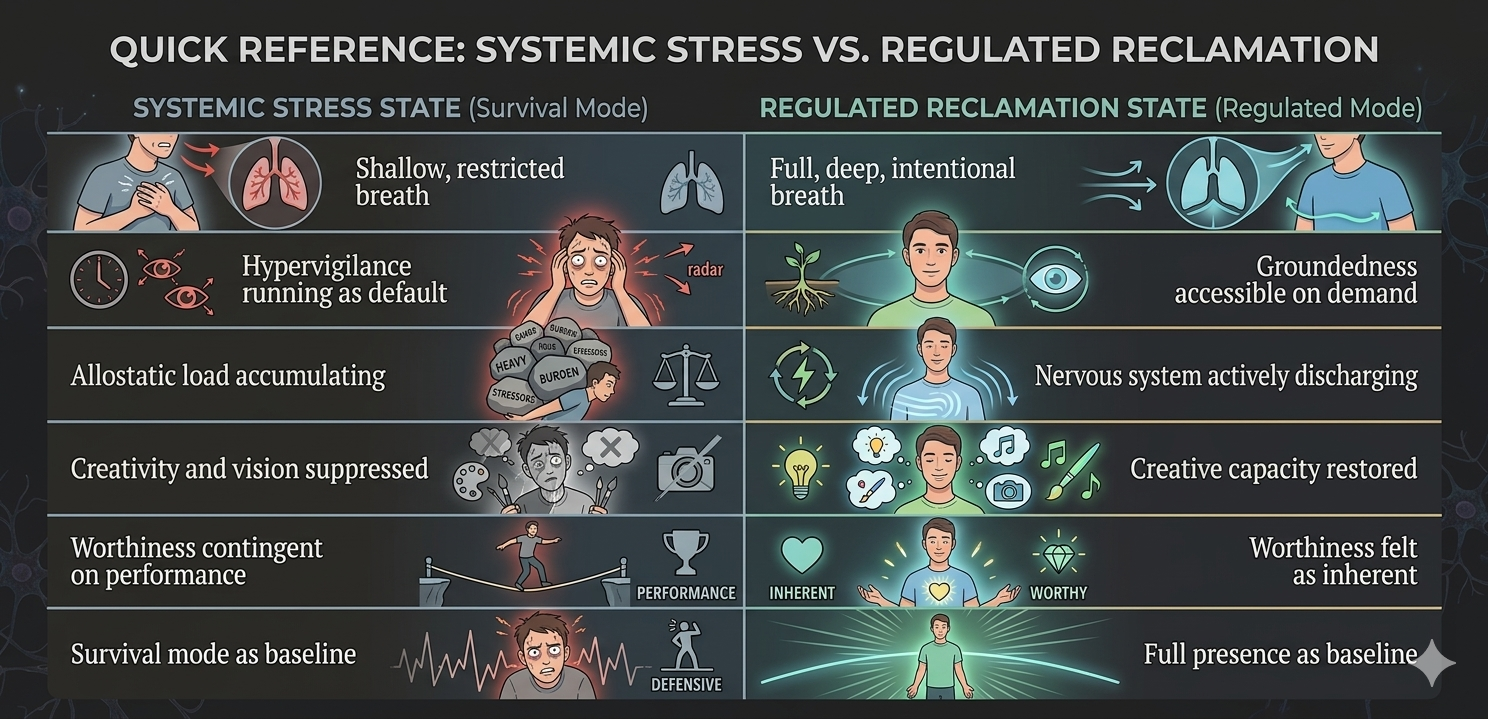
Quick Reference: Systemic Stress vs. Regulated Reclamation
Energy of Creation is a 508(c)(1)(a) nonprofit wellness community based in Temple/Belton, Central Texas. Our mission: Breaking Cycles, Building Futures.


