5 Conscious Breathwork Patterns That Shift Anxiety, Energy, and Focus in Minutes
By Destinē The Leader | Energy of Creation
Conscious breathwork patterns are structured breathing techniques that directly regulate the autonomic nervous system — shifting the body between states of calm, energy, and mental clarity in real time. Unlike casual deep breathing, specific breath patterns change the ratio of inhale to exhale, the pace of breathing, and oxygen-CO₂ balance in ways that produce measurable neurological and physiological effects. These five patterns can be used anywhere, without equipment, and most produce a noticeable shift within the first few minutes of practice.
Why Do Breath Patterns Work So Fast?
The breath is the only autonomic function that is also under voluntary control. Heart rate, digestion, and hormone release all happen without your input — but breathing does too, and can also be consciously directed. This dual nature makes the breath a direct interface with the nervous system.
When you change your breathing pattern deliberately, you change your body's chemistry in real time:
Extending the exhale stimulates the vagus nerve and activates the parasympathetic nervous system — the body's rest-and-digest mode
Deepening and quickening the inhale increases oxygen circulation and stimulates the sympathetic system in a controlled, intentional way
Balancing inhale and exhale regulates the flow between brain hemispheres, improving mental clarity without increasing activation
This is why breath patterns work faster than most stress management tools. You are not managing the stress response from the outside — you are directly interrupting it at the source.
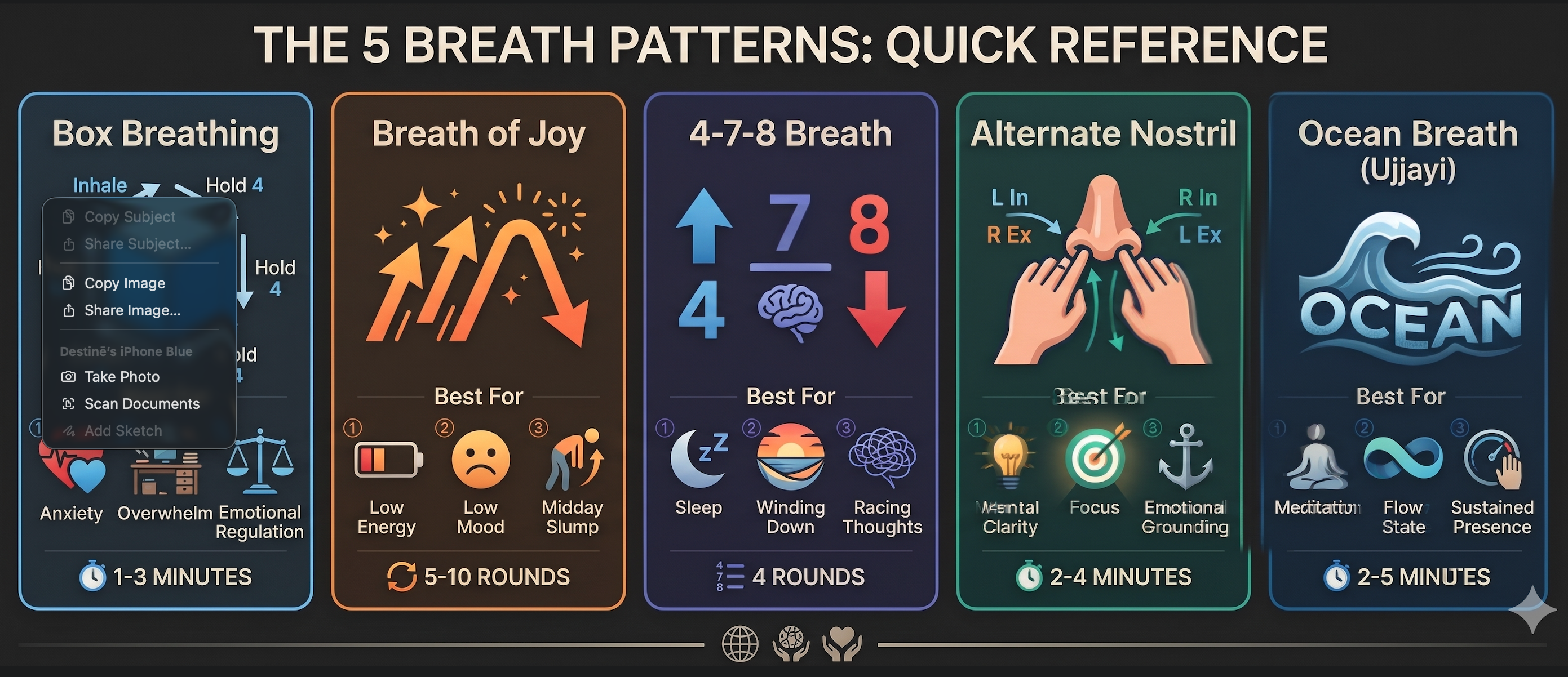
The 5 Breath Patterns: Quick Reference
1. Box Breathing — For Anxiety and Overwhelm
Best for: anxiety, overwhelm, the moment before a hard conversation, emotional regulation
The pattern:
Inhale for 4 counts
Hold for 4 counts
Exhale for 4 counts
Hold for 4 counts
Repeat for 1–3 minutes.
Why it works: The equal-ratio structure of box breathing signals to the brain that the environment is safe. Cortisol begins to drop. Heart rate variability increases. The mental loop most anxiety operates within starts to loosen — not because you thought your way out of it, but because your nervous system received a direct physiological signal that the threat has passed.
How to deepen it: Visualize tracing the four sides of a square as you move through each phase. The visual anchor gives the analytical mind something to do while the nervous system does the actual work.
2. Breath of Joy — For Energy and Low Mood
Best for: midday slump, low mood, that 2pm fog, feeling stuck or flat
The pattern:
Inhale ⅓ of your breath as your arms swing forward
Inhale another ⅓ as your arms open out to the sides
Inhale the final ⅓ as your arms sweep overhead
Exhale fully with an audible "ha!" as you fold forward
Repeat 5–10 rounds.
Why it works: The triple inhale fills the lungs in stages, saturating the body with oxygen. The movement integrates the breath somatically rather than keeping it cerebral. The vocal release on the exhale activates the vagus nerve and generates an immediate endorphin response. You will feel this in the first round.
How to deepen it: Commit fully to the "ha!" exhale. The sound is not optional — it's the mechanism. Volume correlates with release.
3. 4-7-8 Breath — For Sleep and Racing Thoughts
Best for: sleeplessness, racing thoughts, the wired-but-exhausted feeling at the end of the day
The pattern:
Inhale for 4 counts
Hold for 7 counts
Exhale for 8 counts
Repeat 4 rounds.
Why it works: The extended exhale is the key mechanism — exhaling longer than the inhale directly stimulates the parasympathetic nervous system, communicating to the body that it is safe to release. The extended hold gives the body time to absorb and integrate that signal. Four rounds is sufficient to feel a measurable shift in activation level.
How to deepen it: Practice lying down. The horizontal position supports parasympathetic activation. Let the breath count be approximate — the ratio matters more than the precision.
4. Alternate Nostril Breathing — For Mental Clarity and Focus
Best for: mental fog, creative blocks, scattered thinking, before any situation requiring both sharpness and groundedness
The pattern:
Close the right nostril with your thumb. Inhale through the left.
Close the left nostril with your ring finger. Exhale through the right.
Inhale through the right.
Close the right nostril. Exhale through the left.
That is one round. Continue for 2–4 minutes.
Why it works: Alternate nostril breathing — known in pranayama tradition as Nadi Shodhana — alternates airflow between nostrils in a way that activates the brain's hemispheres in alternating rhythm. This produces a balancing effect on both analytical and intuitive processing. Mental fog clears. Emotional reactivity softens. The effect is subtle during the practice and unmistakable once complete.
How to deepen it: Slow the pace as you become more comfortable. The slower the breath, the stronger the regulatory effect.
5. Ocean Breath (Ujjayi) — For Meditation and Sustained Presence
Best for: meditation, flow states, extended practice, any time sustained presence in the body is required
The pattern:
Lightly constrict the back of the throat — the same sensation as fogging a mirror, but through the nose
Breathe slowly and deeply, creating a soft, continuous ocean-like sound on both inhale and exhale
Continue for 2–5 minutes, or throughout a longer practice.
Why it works: Ujjayi is one of the oldest documented pranayama techniques. The sound it creates is both external and internal — you hear it, you feel it in the throat, and that dual sensation makes it significantly harder for the mind to drift than silent breathing. In a full conscious breathwork session, Ujjayi creates the conditions for genuine, natural presence — not forced stillness, but arrived-at stillness.
How to deepen it: Let the sound be consistent on both the inhale and exhale. Inconsistency in the sound indicates tension — use that as feedback to soften.
When to Use Each Pattern: A Practical Guide
What breathing technique is best for anxiety?
Box breathing is the most reliable immediate intervention for anxiety and overwhelm. The equal-ratio structure provides a neural signal of safety faster than most other techniques.
What is the best breathwork for energy?
The Breath of Joy is the most effective pattern for rapidly increasing energy and shifting low mood. The triple inhale, movement, and vocal exhale work simultaneously on oxygenation, somatic engagement, and the nervous system's reward circuitry.
What breathwork helps with sleep?
4-7-8 breathing is specifically designed to activate the parasympathetic nervous system and is most effective for winding down, quieting racing thoughts, and supporting sleep onset.
What breathing technique improves focus?
Alternate nostril breathing (Nadi Shodhana) is the most targeted pattern for mental clarity and focus — particularly useful before creative work, important conversations, or situations requiring both analytical and intuitive engagement.
Beyond Quick Techniques: What a Full Session Does
These five patterns are entry points — real tools that work in real moments. But they are a fraction of what becomes available in a complete conscious breathwork session.
In a full session, rhythmic breathing, intentional breath retention, and music work together to shift brainwave states from beta into alpha and theta — the states associated with deep meditation, creative flow, and genuine rest. Emotional material that can't be accessed through thinking begins to move. The nervous system receives sustained input that creates adaptation over time, not just relief in the moment.
The difference between using a breath pattern for two minutes and completing a full hour-long session is the difference between tasting something and being nourished by it.
Experience a Full Conscious Breathwork Session
Super Sunday is EOC's monthly online conscious breathwork gathering — one hour, first Sunday of every month. A complete session where the full arc of breathwork — including breath retention and the deeper physiological shifts it produces — is guided from start to finish.
Frequency Social Club is EOC's monthly in-person gathering in Central Texas — education, a full breathwork session, and community. The in-person container amplifies the regulatory effect.
BIG VISION is EOC's annual membership for high performers building a consistent breathwork practice alongside sound healing, movement, A Course in Miracles, and full community support.
Energy of Creation is a 508(c)(1)(a) nonprofit wellness community based in Temple/Belton, Central Texas. Our mission: Breaking Cycles, Building Futures.


